Senate
The Senate is the voice of the academic community and the forum where the university’s broad strategic directions are shaped. Through its decisions, it upholds the quality of education, autonomy and UPT’s values.

Role and responsibilities
The Senate is UPT’s highest governing body and plays a key role in defining the university’s main strategic directions. Through its work, it represents the interests of the entire academic community, endorses and complements the initiatives of the executive leadership, and ensures decision-making transparency and university autonomy. It approves the University Charter, the development strategy, long-term objectives, the educational offer and the budget.
University governance instruments
Decisions
The UPT Senate meets regularly to discuss and adopt decisions on key matters affecting university life. Senate decisions are based on proposals from specialist committees, the Board of Administration or the Rector, and are discussed and voted on in plenary sessions.
The decisions adopted by the UPT Senate establish the framework for the university’s operation, covering everything from regulations and strategies to the budget and resource allocation.
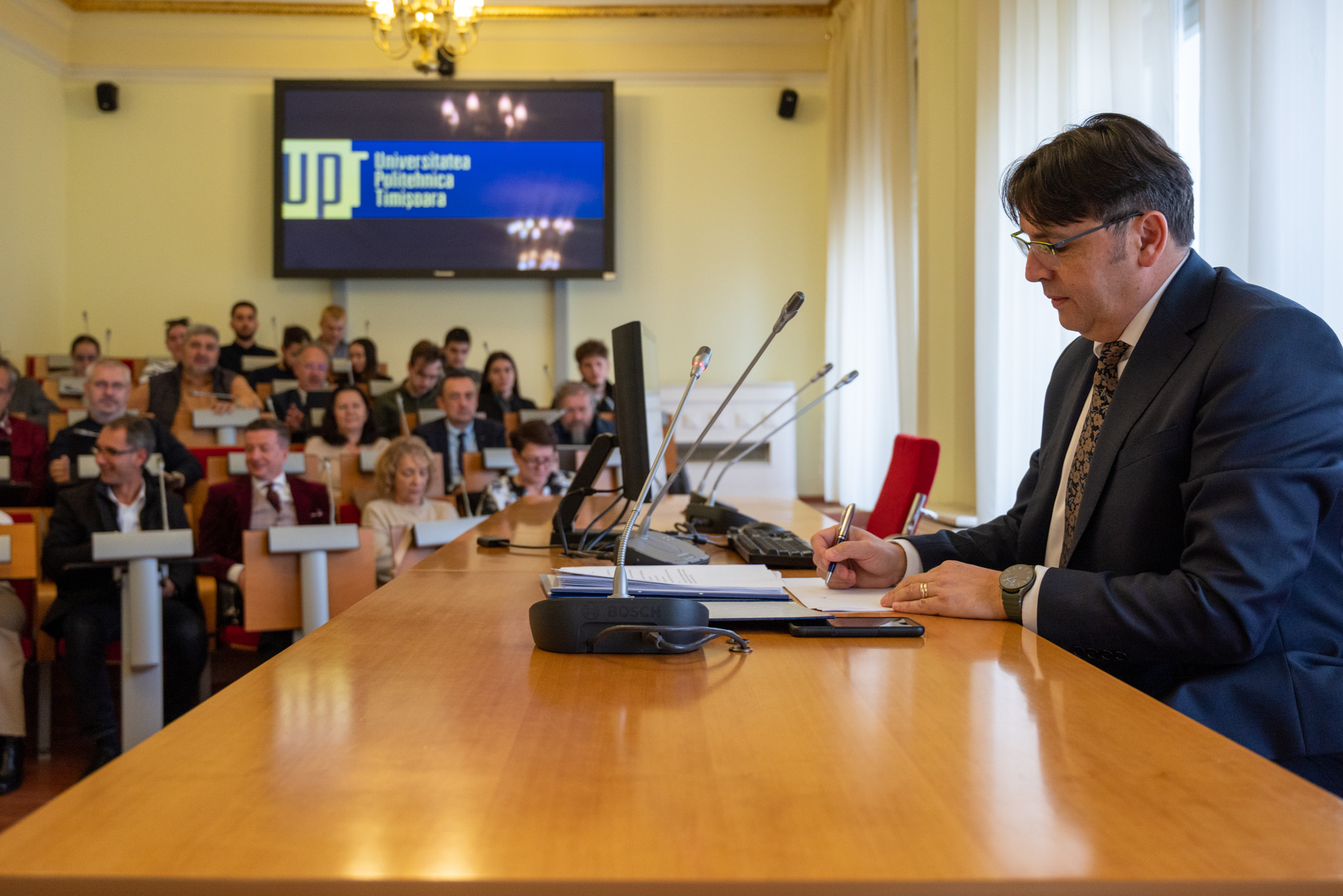
Structure
In the UPT Senate, 75% of members are academic and research staff, while 25% are students. This composition ensures balanced representation and a shared voice for the entire university community.
Leadership
The Senate is led by a Chair elected by secret ballot, supported by four Vice-Chairs and a Secretary-General. Together, they coordinate the work of the specialist committees and the proceedings of plenary sessions.






Senate Bureau
The Senate Bureau consists of the Chair, Vice-Chairs and Secretary-General of the Senate, as well as the chairs of the Senate’s specialist committees.
Between Senate meetings, the Bureau prepares the agenda and reviews proposals submitted by the committees, the Board of Administration or the Rector. It supports the work of the Senate but cannot adopt Senate decisions.
Specialist committees
The Senate’s committees develop regulations, review internal processes and propose solutions to ensure the smooth operation of the university. They cover a wide range of areas, from institutional strategy, human resources and research to international relations, digitalisation and student affairs.